Showing posts with label Poets. Show all posts

Monday, 24 April 2017

50 Short Best Quotes By William Shakespeare


1. Love all, trust a few, do wrong to none.

2. ‘Doubt that the stars are fire, Doubt that the sun doth move his aides, Doubt truth to be a liar, But never doubt I love’

3. Be not afraid of greatness: some are born great, some achieve greatness, and some have greatness thrust upon them.

4.To thine own self be true, and it must follow, as the night the day, thou canst not then be false to any man.

5. The course of true love never did run smooth.

6.There is nothing either good or bad, but thinking makes it so.

7. Love looks not with the eyes, but with the mind; and therefore is winged Cupid painted blind.

8. Cowards die many times before their deaths; the valiant never taste of death but once.

9. If music be the food of love, play on.

10. Life ... is a tale Told by an idiot, full of sound and fury, Signifying nothing.

11. Men at some time are the masters of their fates: The fault, dear Brutus, is not in our stars, but in ourselves, that we are underlings.

12. To be, or not to be: that is the question

13. This above all: to thine own self be true

14. Though this be madness, yet there is method in 't.

15. That it should come to this!

16. There is nothing either good or bad, but thinking makes it so

17. I will speak daggers to her, but use none

18. When sorrows come, they come not single spies, but in battalions

19. A little more than kin, and less than kind

20. The play 's the thing wherein I'll catch the conscience of the king

21. How bitter a thing it is to look into happiness through another man's eyes!

22. True is it that we have seen better days

23. The fool doth think he is wise, but the wise man knows himself to be a fool

24. The world is grown so bad, that wrens make prey where eagles dare not perch

25. Good Night, Good night! Parting is such sweet sorrow, that I shall say good night till it be morrow.

26. What's in a name? That which we call a rose by any other name would smell as sweet

27. But love is blind, and lovers cannot see

28. Our doubts are traitors, and make us lose the good we oft might win, by fearing to attempt

29. Some rise by sin, and some by virtue fall

30. The miserable have no other medicine but only hope

31. A man can die but once

32. Delays have dangerous ends

33. True nobility is exempt from fear

35. what 's done is done

36. I dare do all that may become a man; Who dares do more is none

37. Look like the innocent flower, but be the serpent under 't

38. I am a man more sinned against than sinning

39. My love's more richer than my tongue

40. Nothing will come of nothing.

41. The worst is not, So long as we can say, 'This is the worst.

42. The game is up

43. Love sought is good, but giv'n unsought is better

44. Everyone can master a grief but he that has it

45. The common curse of mankind, - folly and ignorance
46. Nature teaches beasts to know their friends

47. These words are razors to my wounded heart

48. For the rain it raineth every day

49. A friend should bear his friend's infirmities.

50. I would not wishAny companion in the world but you.

Tuesday, 16 August 2016

All You Want to Know About D. H. Lawrence


The English poet, novelist, essayist, playwright and critic David Herbert Richard Lawrence (D. H. Lawrence) was born in Nottinghamshire, England in 1885, he is one among the influential writer of twentieth century. His works was banned until 1959 in United States. Lawrence's collected work is a masterpiece which exposes the dehumanizing nature of the modern world,in the second half of his life he had face many issues that causes more enemies to him because of his creative and bold writing. E. M. Forster addressed him as  "The greatest imaginative novelist of our generation". 


Born
David Herbert Richards Lawrence
11 September 1885
Eastwood, Nottinghamshire, England, United Kingdom
Died
2 March 1930 (aged 44)
Vence, France
Occupation
Novelist, poet
Nationality
British
Alma mater
University of Nottingham
Period
1907–1930
Genre
Modernism
Notable works
·         Novel:
Sons and Lovers
The Rainbow
Women in Love
John Thomas and Lady Jane
Lady Chatterley's Lover
·         Short Story:
Odour of Chrysanthemums
The Virgin and the Gypsy
The Rocking-Horse Winner


Facts

  • D.H. Lawrence's first book The White Peacock was published in 1910.
  • His second novel was The Trespasser, published in 1912.
  • D. H. Lawrence proposed to Louie Burrows, an old college friend. Soon after he met his old professor's wife Frieda von Richthofen and fell in love with her.
  • D. H. Lawrence's first play The Daughter-in-Law was published in 1912.
  • In 1913 D. H. Lawrence published Love Poems and Others, a book of poetry.
  • D. H. Lawrence and Frieda married on July 13th, 1914.
  • His next book The Prussian was a short story collection.
  • In 1915 D.H. Lawrence's book The Rainbow was published but was condemned for its sexual content.
  • With World War I, D.H. Lawrence and his German wife were banished from Cornwall and they traveled continuously, staying with friends. During this time he published four more poetry books including Amores, Look! We Have Come Through!, New Poems, and Bay: A Book of Poems.
  • In 1920, in Italy, D.H. Lawrence published Women in Love, and in 1922 a book of short stories titled My England and other Stories was published.
  • D.H. Lawrence traveled to America in 1922, and wrote Studies in Classic American Literature.
  • D. H. Lawrence wrote Boy in the Bush (1924), St. Mawr (1925), and The Plumed Serpent (1926) while in the United States, on a ranch in New Mexico.
  • He went back to Italy in 1927 after developing tuberculosis. There he wrote Lady Chatterley's Lover. It was published in Italy in 1928, but it was banned in the United States until 1958 due to its graphic sexual content. It was banned in England until 1960, until a jury ruled in favor of Penguin Books.
  • D.H. Lawrence died in Venice, Italy at the age of 44, on March 2nd, 1930.
  • Although he had been considered a crude writer during his lifetime, his works have become well-regarded and he is now considered to be one of the 20th century's greatest modernist writers.

Famous Quotes Of D.H. Lawrence


"But better die than live mechanically a life that is a repetition of repetitions."

"My God, these folks don't know how to love - that's why they love so easily. "

"I want to live my life so that my nights are not full of regrets."

"Life is ours to be spent, not to be saved."

"Love is the flower of life, and blossoms unexpectedly and without law, and must be plucked where it is found, and enjoyed for the brief hour of its duration."

"Never trust the artist. Trust the tale."

"Ours is essentially a tragic age, so we refuse to take it tragically."

"Life is a travelling to the edge of knowledge, then a leap taken."

"Men! The only animal in the world to fear. "

"In every living thing there is the desire for love. "

Saturday, 13 August 2016

David Mitchell - A Versatile Contemporary Writer


There are many writers in the universe who are exceptionally well in analyzing the historical facts and narrate it. Many writers are very skilled in anticipating the future and write it in their typical style, but only very few writers can able to write on both and David Mitchell is one among them. David Stephen Mitchell was born in England on January 12, 1969, he is one among the successful novelist of the present era. Mitchell is an author of seven prosperous novels and two of them were shortlisted for The Booker Prize. And his very recent work "From Me Flows What You Call Time" will be published in the year of 2114. He is a man of past, present and future. 

Mitchell's Works

  • Ghost Written(1999)
  • number9dream (2001)
  • Cloud Atlas(2004)
  • Black Swan Green(2006)
  • The Thousand Autumn of Jacob De Zoet(2010)
  • The Bone Clocks(2014)
  • Slade House(2015)


Ghost written

This novel was written in an unique style and thoughts of Mitchell. The book is about nine parts of the world and the people who live in it. Each section is a new plot with a central character and also about few fellow humans and the beauty of this novel is having a connectivity among those nine different places in the world. David Mitchell introduced a new theory of coincidence and inter-connectivity to fictions. A well-structured book speaks about almost every problem and complications of the human kind.  

number9dream

number9dream has been shortlisted for the Booker prize, this plot is about a young nineteen year old boy Eiji, who search his father and also mourns for the death of his twin sister. It presents the complexity of understanding the identity and imaginative journey of one's own life. “Number9Dream, with its propulsive energy, its Joycean eruption of language and playfulness, represents further confirmation that David Mitchell should be counted among the top young novelists working today.”—San Francisco Chronicle

Cloud Atlas

Mitchell has showed his extra-ordinary excellence in this novel. This books has been adopted into movie and succeed as well. It has won British Book Award and shortlisted to Booker Prize in the year 2004. Six different stories in the six different period of time has been presented simultaneously with a deep connectivity. The book has been started in nineteenth century and traveled to the post-apocalyptic future. “Cloud Atlas ought to make [Mitchell] famous on both sides of the Atlantic as a writer whose fearlessness is matched by his talent.”—The Washington Post Book World

Black Swan Green

This book is a semi-autobiographical novel of Mitchell, it has 13 sections each one is the happenings of every month from January 1982 to January 1983, the story has been written in the perspective of 13 year old boy. This book has been long-listed for the Booker prize in 2006. “[David Mitchell is a] prodigiously daring and imaginative young writer. . . . As in the works of Thomas Pynchon and Herman Melville, one feels the roof of the narrative lifted off and oneself in thrall.”—Time

The Thousand Autumn of Jacob De Zoet

The Thousand Autumn of Jacob De Zoet is a historical novel of Japan. During the Dutch Trading with Japan and he described the state of the country and the measures taken by them inorder to protect themselves from the outsiders of Japan. Mitchell explains the pain and pleasure of the man in the Age of Exploration. “By any standards, The Thousand Autumns of Jacob de Zoet is a formidable marvel.”—James Wood, The New Yorker

The Bone Clocks

David Mitchell's sixth book, this book has won World Fantasy Award in 2015. This title refers to the immortality of the characters in the book that compared with the normal mortal bones of humans. This story is about a woman who has an invisible eye and the war between two immortals. “Intensely compelling . . . fantastically witty . . . offers up a rich selection of domestic realism, gothic fantasy and apocalyptic speculation.”—The Washington Post

Slade House

Each Mitchell's novel has a specific and unique elements, Slade House is also one of its kind. This novel is a collection of twitts in Twitter by Mitchell himself. The plot starts in seventeenth century and ends up to the present year which means 2015 and its about a mysterious slade house. “Diabolically entertaining . . . dark, thrilling, and fun . . . a thoroughly entertaining ride full of mind games, unexpected twists, and even a few laughs.”—The Daily Beast

Other Works - Short stories
  • "January Man", Granta 81: Best of Young British Novelists, Spring 2003
  • "What You Do Not Know You Want", McSweeney's Enchanted Chamber of Astonishing Stories, Vintage Books (Random House), 2004
  • "Acknowledgments", Prospect, 2005
  • "Preface", The Daily Telegraph, April 2006
  • "Dénouement", The Guardian, May 2007
  • "Judith Castle", New York Times, January 2008
  • "An Inside Job", Included in "Fighting Words", edited by Roddy Doyle, published by Stoney Road Press, 2009 (Limited to 150 copies)
  • "The Massive Rat", The Guardian, August 2009
  • "Character Development", The Guardian, September 2009
  • "Muggins Here", The Guardian, August 2010
  • "Earth calling Taylor", Financial Times, December 2010
  • "The Siphoners", Included in "I’m With the Bears: Short Stories from a Damaged Planet", 2011
  • "The Gardener", in the exhibit "The Flower Show" by Kai and Sunny, 2011 (Limited to 50 copies)
  • "Lots of Bits of Star", in the exhibit "Caught by the Nest" by Kai and Sunny, 2013 (Limited to 50 copies)
  • "Variations on a Theme by Mister Donut", Granta 127: Japan, Spring 2014
  • "The Right Sort", Twitter, 2014
DM's Quotes 

“My life amounts to no more than one drop in a limitless ocean. Yet what is any ocean, but a multitude of drops?” 

“A half-read book is a half-finished love affair.”

“I believe there is another world waiting for us. A better world. And I'll be waiting for you there.” 

“Travel far enough, you meet yourself.” 

“A book you finish reading is not the same book it was before you read it.” 

“Whoever opined "Money can't buy you happiness" obviously had far too much of the stuff.” 

“We have just enough religion to make us hate, but not enough to make us love.” 

“One fine day a predatory world shall consume itself.” 

“By each crime and every kindness, we birth our future.” 

“Writing is such a damn lonely sickness.” 

“Lying's wrong, but when the world spins backwards, a small wrong may be a big right.”


Wednesday, 20 July 2016

Alfred, Lord Tennyson


Alfred, Lord Tennyson, the man who is famous for his short lyrics and dramatic monologues was born in England in 1809, a well-known poet of Victorian period. In his early stage of life he used to attempt dramas but plays are more successful than them. The Oxford Dictionary of Quotations named Tennyson as ninth most frequently quoted writer. His works are majorly have the themes of classical mythology, historical and political, but he is a writer of all matters. Tennyson was influenced by Byron and Scott poetry from his childhood, his early works has the reflection of his influences. 

Name : Alfred, Lord Tennyson
Born : 6 August 1809
Died: 6 October 1892
Genre: Lyric and Short narrative poems
Major Works:  “The Battle of Brunanburh”, “Crossing the Bar”, The Idylls of the King, In Memoriam, “The Lady of Shalott”, “The Lotus Eaters”, “The Palace of Art”, “Mariana”, “St. Simeon Stylites”, “Tithonus”, “Ulysses”.

In Memoriam, is written in the memory of the poet's beloved friend Arthur Henry Hellem who died in the age of 22 due to ague in 1849. The Lotus Eaters is a poetry collection published in the year of 1832, Tennyson wrote this in the influence of his trip to Spain with his friend Hellem, this poem describes about a group of a mariners who ate lotus leaves and attain a altered state. The poem 'Ulysses' is one of the most notable and famous work done by this poet, this poem is written in blank verse in 1833 but published in the year 1842 in the dramatic monologue form. Ulysses is a famous character in literature first recorded in Iliad and Odyssey by Homer in 800 B.C. In this Tennyson's poem Ulysses, mythical hero describes his own restlessness to return to his kingdom to meet his wife and son again after the war. 


Quotes of Alfred, Lord Tennyson

"o strive, to seek, to find, and not to yield."

"I am a part of all that I have met."

"Knowledge comes, but wisdom lingers."

"Theirs is not to make reply: Theirs is not to reason why: Theirs is but to do and die."

"If I had a flower for every time I thought of you, I could walk in my garden forever."

"There lives more faith in honest doubt, believe me, than in half the creeds."

"Hope smiles on the threshold of the year to come, whispering that it will be happier."

"Dreams are true while they last, and do we not live in dreams?"


Books


Friday, 8 July 2016

George Orwell - Eric Arthur Blair


George Orwell(1903- 1950), one of the greatest writer of twentieth century was born in Bengal, India (British India). He is originally called as Eric Arthur Blair but use his pen name George Orwell widely, he was an essayist, critic, novelist and journalist. 'The Times' in 2008 gave him the second position of 'The 50 greatest British Writers Since 1945'. He writes lot about social injustice and he supports democratic socialism. His father was a British Colonial Civil Servant and he follows his father's footstep he too contributed to Indian Imperial Police till 1927. Orwell is well-known for his anti- fascism, anti- communism and literary criticism. 

Name: George Orwell
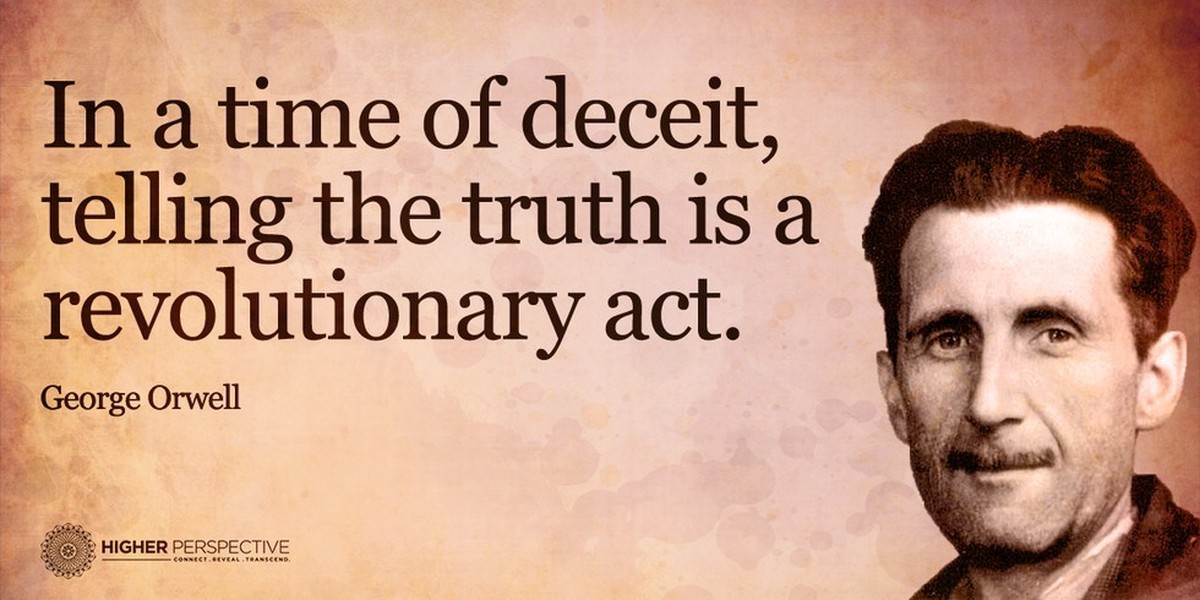
George Orwell
Pen name: Eric Arthur Blair 
Born: 25 June 1903
Died: 21 January 1950
Birth place: India
Genre: Satire, Dystopia 
Major Works: Animal Farm, 1984, Homage to Catalonia, Burmese Days

Animal Farm is published in the year 1945 which is a dystopian and allegorical novel. Orwell was influenced by Spanish Civil War, he mentioned the seriousness of totalitarian government and heels of World War II in this novel. He faced many troubles for pubishing this novel but later this book brings him a great success. And in 1949, Orwell published the book 1984, it is a social science fiction and has lot of political elements present in this novel. The Time magazine includes this book among the 100 best English novels from 1923 to 2005. 


In his essay Politics and the English Language (1946), Orwell wrote about the importance of precise and clear language, arguing that vague writing can be used as a powerful tool of political manipulation because it shapes the way we think. In that essay, Orwell provides six rules for writers:

1. Never use a metaphor, simile or other figure of speech which you are used to seeing in print.

2. Never use a long word where a short one will do.

3. If it is possible to cut a word out, always cut it out.

4. Never use the passive where you can use the active.

5. Never use a foreign phrase, a scientific word or a jargon word if you can think of an everyday English equivalent.

6. Break any of these rules sooner than say anything outright barbarous.

Famous Quotes of George Orwell

"If you want a vision of the future, imagine a boot stamping on a human face - forever."

"Who controls the past controls the future. Who controls the present controls the past."

"All animals are equal, but some animals are more equal than others."

"War is peace. Freedom is slavery. Ignorance is strength."


"Freedom is the right to tell people what they do not want to hear."

"War against a foreign country only happens when the moneyed classes think they are going to profit from it."


"Every generation imagines itself to be more intelligent than the one that went before it, and wiser than the one that comes after it."


Books to read..


Tuesday, 28 June 2016

Jane Austen - A Prominent writer


Jane Austen is one of the most widely read writer in the history of English Literature. She was born in 1775 in Hampshire, her novels are set in both middle and upper class society and their life styles are deeply discussed especially the characteristics of women. Mostly her works have attributes of literary realism, sentimental, parody, comics and free indirect speech. And also the plots often speaks about the dependence of women on marriage in the motto of economic security and favorable social standing. Austen's works are inspired by the contemporary readers and adapted her works into film.

Name: Jane Austen
Signature
Born: 16th December 1775, UK
Died: 18th July 1817
Genre: Romance, Fiction
Major Works: Pride and Prejudice, Sense and Sensibility, Emma, Persuasion 

Sense and Sensibility is actually an epistolary was written when Austen was 19 years old, it was written in the middle of two cultural movements Classicism and Romanticism. Austen never loses sight of economic practicalities, propriety, and perspective. Then she wrote Pride and Prejudice and it is a novel of manners and it consist the elements of admiration of love, courtship and marriage, reputation and class. This is the most famous work done by this great writer and still the novel has huge set of fans. Emma is also a notable work of Jane Austen, it follows the themes of social status and the confined nature of women's existence. 

Famous Quotes:


"If I loved you less, I might be able to talk about it more."

"To be fond of dancing was a certain step towards falling in love."

“Let us never underestimate the power of a well-written letter.”

"One half of the world cannot understand the pleasures of the other."

“Her heart did whisper that he had done it for her.”

"A large income is the best recipe for happiness I ever heard of."

"A lady's imagination is very rapid; it jumps from admiration to love, from love to matrimony in a moment."

"Friendship is certainly the finest balm for the pangs of disappointed love."

"Ah! There is nothing like staying at home, for real comfort."

Amazing Editions:

Tuesday, 21 June 2016

Jonathan Swift - Foremost Prose Satirist


Jonathan Swift(1667 - 1745) is a satirist, essayist, Anglo-Irish and one of the major poet of Augustan Age. Swift wrote many famous fictions and the most notable work Gulliver's Travel in 1726. He formed a literary club in 1713 along with Alexander Pope and other famous poets of that period and also he became the dean of St. Patrick's, Dublin. After the death of his beloved wife Stella, Swift's health becomes unstable due to the grief and he died in 1745. 

Notable Works:
Signature
  • Gulliver's Travel 
  • A Modest Proposal
  • A Tale of a Tub
  • The Battle of the Books
  • Drapier's Letter

Gulliver's Travel is the masterpiece done by Swift was published in four books, the first book was published without any author 's name in the title of Travels into Several Remote Nations of the world and with the touch of satire. The theme is all about the protagonist travels all around the world and meet different structured people those who are too tall or too short, this work is famous till now among children and even adults. The Battle of the Books is first published in 1704 which is a mock heroic work, the battle between the books in King's library. 

Gulliver's Travel

Quotes of Jonathan Swift

"The proper words in the proper places are the true definition of style."

"Vision is the art of seeing things invisible."

"He was a bold man that first ate an oyster."


"Satire is a sort of glass, wherein beholders do generally discover everybody's face but their own."

"A wise man should have money in his head, but not in his heart."

"We have just enough religion to make us hate, but not enough to make us love one another."

"No wise man ever wished to be younger."

"Books, the children of the brain. "

"There is nothing constant in this world but inconsistency. "


Books under Rs. 100:

Sunday, 19 June 2016

Famous English Authors in Chronological Order

This is a list of popular writers in English Literature with their period of living. This gives you a outlook of which author belongs to which period. This post is a recap of the history in a single list, hope this will be helpful for students, beginners and those who prepare for UGC NET. 


  1. Geoffrey Chaucer (1343 - 1400)
  2. Sir Thomas More(1478 - 1535)
  3. Edmund Spenser(1552 - 1599)
  4. John Donne(1573 - 1631)
  5. Francis Bacon(1561 - 1626)
  6. Christopher Marlowe (1564 - 1593)
  7. William Shakespeare (1564 - 1616)
  8. James I King of England (1566 - 1625)
  9. Ben Jonson(1573 - 1637)
  10. John Milton (1608 - 1674)
  11. John Dryden (1631 - 1700)
  12. Daniel Defoe (1660 - 1731)
  13. Jonathan Swift(1667- 1745)
  14. Alexander Pope (1688 - 1744)
  15. Henry Fielding (1707 - 1754)
  16. Samuel Johnson (1709 - 1784)
  17. Oliver Goldsmith (1730 - 1774)
  18. Fanny Burney (1752 - 1840)
  19. William Wordsworth (1770 - 1850)                                           
  20. Sir Walter Scott (1771 - 1832)
  21. Samuel Taylor Coleridge (1772 - 1834)
  22. Jane Austen (1775 - 1817)
  23. Lord Byron (1788 - 1824)
  24. Percy Bysshe Shelley (1792 - 1822)
  25. John Keats (1795 - 1821)
  26. Thomas Carlyle (1795 - 1881)
  27. Mary Shelley (1797 - 1817)
  28. William Makepeace Thackeray (1811 - 1863)
  29. Charles Dickens (1812 - 1870)
  30. Anthony Trollope (1815 - 1882)
  31. Charlotte Brontë (1816 - 1855)
  32. Emily Brontë (1818 - 1848)
  33. George Eliot Mary Ann (Marian) Evans (1819 - 1880)
  34. Anne Brontë (1820 - 1849)
  35. Samuel Butler(1835 - 1902)
  36. Thomas Hardy (1840 - 1928)
  37. Gerard Manley Hopkins (1844 - 1889)
  38. Robert Louis Stevenson (1850 - 1895)
  39. Oscar Wilde(1856 - 1900)

  40. Joseph Conrad (1857 - 1924)
  41. Rudyard Kipling (1865 - 1936) Nobel Prize in Literature, 1907
  42. H.G. (Herbert George) Wells (1866 - 1946)
  43. John Galsworthy (1867 - 1933) Nobel Prize in Literature, 1932
  44. Bertrand Russell (1872 - 1970) Nobel Prize in Literature, 1950
  45. Ford Madox Ford (1873 - 1939)
  46. Sir Winston Churchill (1874 - 1965) Nobel Prize in Literature, 1953
  47. William Somerset Maugham (1874 - 1965)
  48. E.M. Forster (1879 - 1970)
  49. Sir P. G. Wodehouse (1881 - 1975)
  50. Virginia Woolf (1882 - 1941)
  51. D.H. Lawrence (1885 - 1930)
  52. T. S. Eliot (1888 - 1965) Nobel Prize in Literature, 1948
  53. J.R.R. Tolkien (1892 - 1973)
  54. Aldous Huxley (1894 - 1963)
  55. Robert Graves (1895 - 1985)
  56. George Orwell ( 1903 - 1950)
  57. Evelyn Waugh (1903 - 1966)
  58. Graham Greene (1904 - 1991)
  59. Richard Llewellyn (1906 - 1983)
  60. Sir William Golding (1911 - 1993) Nobel Prize in Literature, 1983
  61. Lawrence Durrell (1912 - 1990)
  62. Patrick White (1912 - 1990) Nobel Prize in Literature, 1973
  63. Dylan Thomas (1914 - 1953)
  64. Denton Welch (1915 - 1948)
  65. Anthony Burgess (1917 - 1993)
  66. Dame Iris Murdoch (1919)
  67. Doris Lessing (1919)
  68. Philip Larkin (1922 - 1985)
  69. Sir Kingsley Amis (1922 - 1995)
  70. Tom Sharpe (1928)
  71. Ted Hughes (1930 - 1998)
  72. J.G. Ballard (1930)
  73. Harold Pinter (1930)
  74. John Le Carre (1931)
  75. Sir V. S. (Vidiadhar Surajprasad) Naipaul (1932) Nobel Prize in Literature, 2001
  76. Salman Rushdie (1947)
  77. Ian McEwan (1948)
  78. Martin Amis (1949)
  79. Samuel Beckett
  80. John Osborne

Wednesday, 15 June 2016

Charles Dickens - The Greatest Novelist of the Victorian Era


The creator of most amazing fictional characters in the Victorian period and the greatest novelist, Charles John Hoffam Dickens was born in 1812 and died in 1870, he lived a wonderful life of 58 years as a social critic and English famous writer and later becomes a favorite author to the literature readers even in the modern era and  especially for youngsters. He wrote fifteen novels and few short stories, he concern more about the low class society and the indifference among the people widely in his works. In his personal life he suffered a lot due to poverty. His works and the characters he created live as long as the world exist. 


Notable Works of Dickens

Charles Dickens
  • Oliver Twist
  • A Christmas Carol
  • David Copperfield
  • Hard Times
  • A Tale of Two Cities
  • Great Expectations

David Copperfield is a semi-autobiography of Dickens, he is influenced by the hard experiences he overcome in his personal life. Both Oliver Twist and A Christmas Carol speaks lot but the sufferings of low classes and the poverty. A Tale of Two Cities is an all time favorite for many people, it concern more about the French Revolution in both positive and negative aspects. The characters of the novel has a unique quality and creates a deep feeling on the reader's mind.  


Most Famous Quotes:


"Have a heart that never hardens, and a temper that never tires, and a touch that never hurts."

"No one is useless in this world who lightens the burdens of another."

"It was the best of times, it was the worst of times."

"It is a far, far better thing that I do, than I have ever done; it is a far, far better rest that I go to, than I have ever known."

"A loving heart is the truest wisdom."

"The pain of parting is nothing to the joy of meeting again."

"I will honor Christmas in my heart, and try to keep it all the year."

"To conceal anything from those to whom I am attached, is not in my nature. I can never close my lips where I have opened my heart."

"We need never be ashamed of our tears."


Friday, 10 June 2016

R. K. Narayan - Indian Novelist

R. K. Narayan (Rasipuram Krishnaswami Iyer Narayanaswami) is a well known Indian writer who was born in 1906 in Madras, he is popular for his typical style of writing. He is one among the greatest Indian writers in English like Raja Rao and Mulk Raj Anand. He creates a fictional town called Malgudi and used it in most of his work. Narayan's work always holds elements like humanism and ordinary life of a man. And he died in 2001 after achieving many honors and awards like Sahitya Academy award for his work The Guide, AC Benson Medal, Padma Bhushan and Padma Vibhushan awards.


Major Works:
  • The Bachelor of Arts
  • The Dark Room
  • The English Teacher
  • The Financial Expert
  • The Guide
  • The Man- Eater of Malgudi
  • The Vendors of Sweets
  • Malgudi Days
  • The Grandmother's Tale

His works hold a humorous and simple style of writing, Specially his novel Swami and Friends is a semi autobiography which reflects the life of young people of south India. And his novel The Guide is one of the popular work written by him, it is adopted into film after its massive success of the novel. We can say that he is one of pioneer to all Indian - English writers of the present era. 


Famous Quotes of R. K


“life is about making right things and going on..”

“We always question the bonafides of the man who tells us unpleasant facts.”

“No one ever accepts criticism so cheerfully. Neither the man who utters it nor the man who invites it really means it.”

“How can two living entities possessing intelligence and judgement ever be tied together for a lifetime?”

“Certain things acquired an evil complexion if phrased, but remained harmless in the mind.”

“Death and its associates, after the initial shock, produce callousness.”

“Do you realize how few ever really understand how fortunate they are in their circumstances?”

“you threw a stone into a gutter it would only spurt filth in your face.”

Books You May Like To Read:


Featured post

Poetic Forms in English

Poetry is the most lovable part of any literature, one cannot cross the literature canel without tasting the sweetest thing called poetry....